Architecture Overview
Vigi uses a distributed microservices architecture designed for scalability, high availability, and fault tolerance. The system is composed of five main server components that work together to provide comprehensive uptime monitoring.
System Architecture
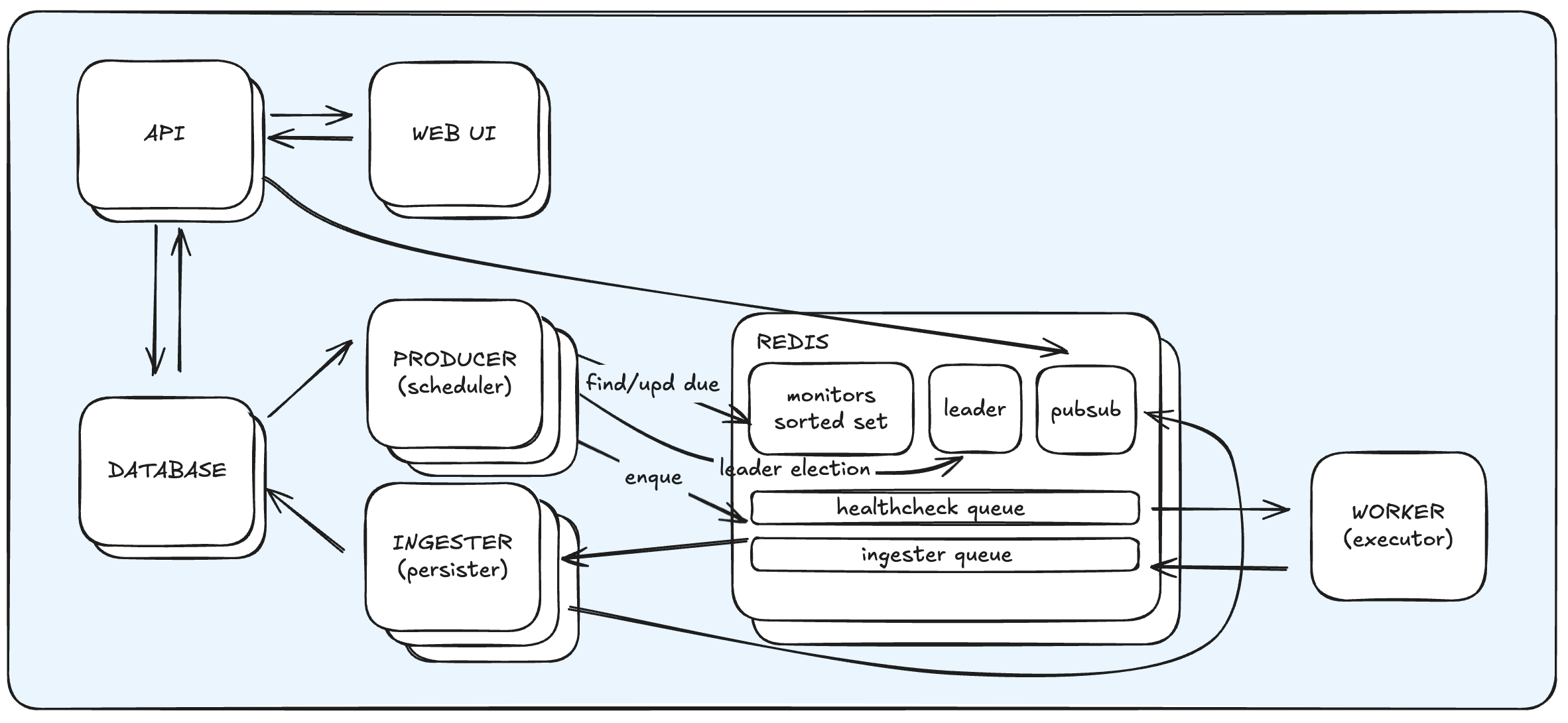
Component Overview
1. API Server
The main HTTP API server that handles all client requests, authentication, and WebSocket connections.
Key Responsibilities:
- RESTful API endpoints
- User authentication and authorization
- WebSocket real-time updates
- Swagger API documentation
- Brute force protection
2. Producer
The scheduling service that manages when monitors should be checked.
Key Responsibilities:
- Scheduling health checks based on monitor intervals
- Leader election for high availability
- Monitor lifecycle management
3. Worker
The execution engine that performs actual health checks.
Key Responsibilities:
- Executing health checks (HTTP, TCP, Ping, DNS, etc.)
- Proxy support
- TLS certificate validation
- Timeout handling
4. Ingester
The data persistence service that processes health check results.
Key Responsibilities:
- Storing health check results (heartbeats)
- Status change detection
- Notification triggering
- TLS certificate storage
- Statistics calculation
5. Migrate
The database migration tool based on Bun.
Key Responsibilities:
- Schema initialization
- Schema migrations (up/down)
- Database versioning
- Multi-database support
Communication Flow
Health Check Flow
- Producer schedules a health check task and adds it to the queue
- Queue (Redis/Asynq) holds the task until a worker is available
- Worker picks up the task, executes the health check, and queues the result
- Ingester processes the result, stores it in the database, and triggers events
- API receives events via Redis pub/sub and pushes updates to connected clients via WebSocket
Event-Driven Architecture
The system uses Redis pub/sub for real-time event communication:
- Monitor status changes
- Heartbeat events
- Notification events
- WebSocket updates
Data Stores
Database (PostgreSQL / MongoDB / SQLite)
- User accounts and authentication
- Monitor configurations
- Heartbeat history
- Notification channels
- Status pages
- Settings and preferences
Redis
- Task queue (via Asynq)
- Event bus (pub/sub)
- Leader election (for producer HA)
- Distributed locks
- Monitors due time sorted set
High Availability Features
Horizontal Scaling
- Multiple producer instances can run simultaneously with automatic leader election:
- Leader handles monitor syncing and scheduling
- All instances can process tasks
- Automatic failover if leader crashes
- Multiple Worker instances can process tasks concurrently
- Multiple Ingester instances can process results concurrently
- Queue-based load distribution ensures even work distribution
Supported Databases
Vigi supports three database backends:
| Database | Use Case | Features |
|---|---|---|
| PostgreSQL | Production deployments | Full feature support, best performance |
| MongoDB | NoSQL requirements | Document-based storage |
| SQLite | Development & small setups | Single file, no server required |
Technology Stack
- Language: Go 1.24+
- Web Framework: Gin
- Database: Bun ORM (SQL) / MongoDB Driver
- Queue: Asynq (Redis-based)
- Event Bus: Redis Pub/Sub
- Logging: Zap
- Dependency Injection: Uber Dig
- Validation: Go Playground Validator
Next Steps
Learn more about each component: